A practical look at the Singleton pattern in C#, with a simple example and clear guidance on when to use it in an ASP.NET Core API.
Intro
When I first came across the Singleton pattern, it looked almost too simple to matter. But once you start building APIs, you quickly notice there are cases where one shared instance makes life easier, especially for things like logging, caching, or application-wide settings.
What Is a Singleton?
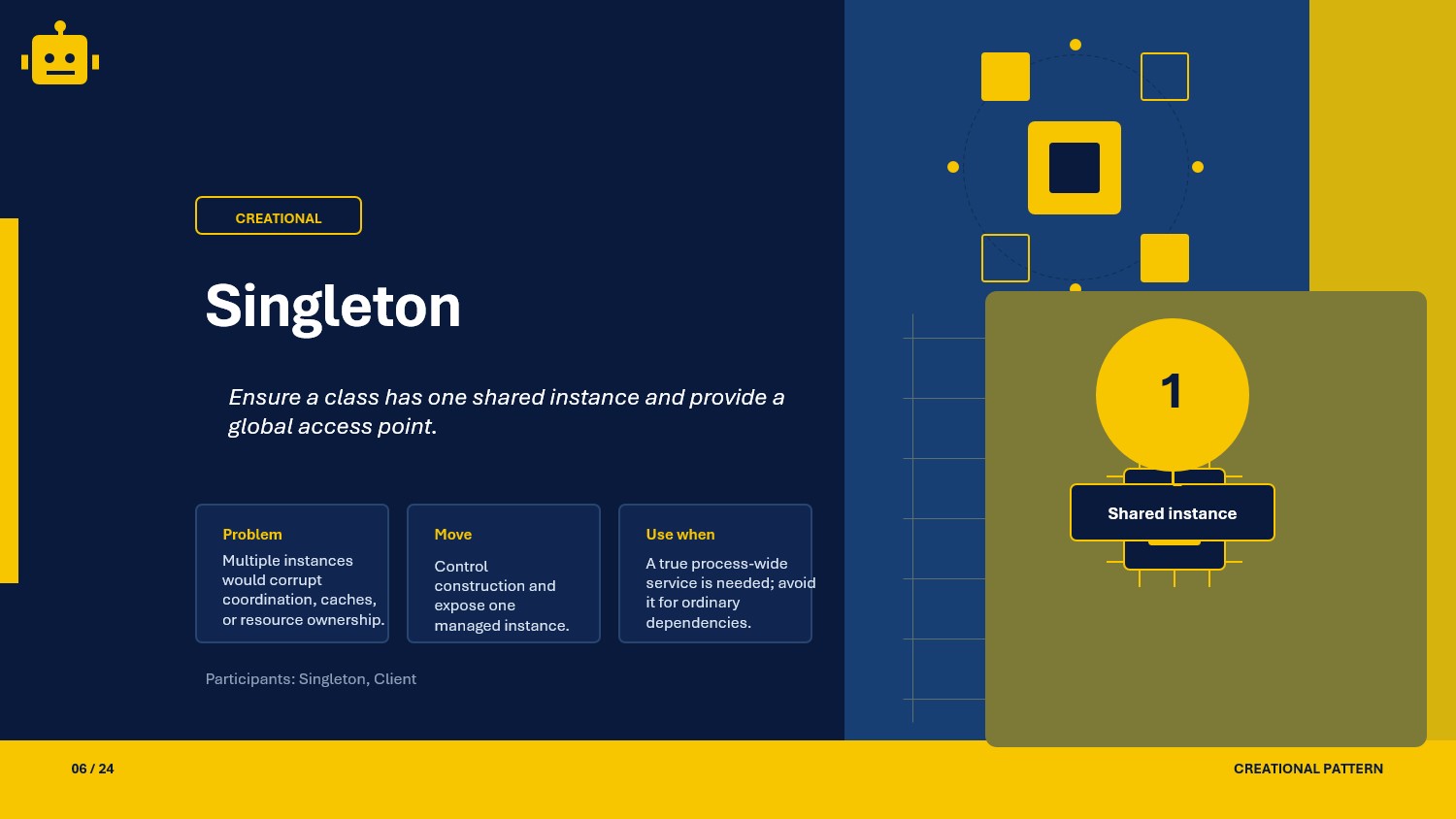
Singleton is a creational design pattern that makes sure a class has only one instance and gives the rest of the application a single, controlled way to access it.
In plain terms, instead of creating the same service again and again, you create it once and reuse it wherever it is needed.
Singleton Class Example
public sealed class ApplicationLogger{    private static readonly Lazy<ApplicationLogger> _instance =        new(() => new ApplicationLogger());
    public static ApplicationLogger Instance => _instance.Value;
    private ApplicationLogger()    {    }
    public void Log(string message)    {        Console.WriteLine($"[{DateTime.UtcNow:O}] {message}");    }}
Usage
var logger = ApplicationLogger.Instance;logger.Log("User profile loaded successfully.");Why This Works
Private Constructor
The private constructor prevents other classes from creating new objects directly.
Single Access Point
Safe Initialization
Lazy<T> delays creation until the object is actually needed and helps with thread safety as well.
When to Use It
Singleton is a good fit when the whole application truly needs one shared object.
- a logger used across services
- a small in-memory cache
- configuration or settings that are reused everywhere
- shared utilities that should keep one consistent state
That said, not every service should be a Singleton. If a class holds request-specific data, making it shared can create bugs very quickly.
Important Note for ASP.NET Core
In ASP.NET Core, you usually do not need to manually code the pattern every time. The built-in dependency injection container already supports singleton lifetime.
builder.Services.AddSingleton<IAppCache, AppCache>();That approach is often cleaner because the framework manages the lifecycle for you, and the code stays easier to test.
Core Components of the Pattern
| Part | Purpose | Example in this article |
|---|---|---|
| Singleton class | Holds the shared behavior | ApplicationLogger |
| Private constructor | Blocks direct object creation | private ApplicationLogger() |
| Static instance | Stores the one object | _instance |
| Public accessor | Returns that shared object | Instance |
Common Singleton Variations
You will usually see Singleton implemented in a few common ways:
Basic Singleton
The most direct version. Easy to understand, but not ideal in multi-threaded scenarios.
Lock-Based Singleton
Uses a lock to make sure two threads do not create two objects at the same time.
Double-Checked Locking
Adds an extra check before locking so the application avoids unnecessary locking after initialization.
Lazy Initialization
This is the cleanest option in modern C#. The object is created only when it is first needed.
Eager Initialization
The instance is created as soon as the class is loaded. It is simple, but it may create the object earlier than necessary.
How the Variations Differ
| Variation | Creation time | Thread-safe | Best use case |
|---|---|---|---|
| Basic | Immediate or simple access | No | Learning the pattern |
| Lock-based | On first use | Yes | Multi-threaded apps |
| Double-checked locking | On first use | Yes | Reduced locking overhead |
| Lazy initialization | On first use | Yes | Preferred modern approach |
| Eager initialization | At startup | Yes | When early creation is acceptable |
SOLID Principles Behind It
SRP — Single Responsibility Principle
The class focuses on one responsibility: managing a single shared instance and its behavior.
OCP — Open/Closed Principle
You can change how Singleton is implemented without changing how the rest of the application uses it.
DIP — Dependency Inversion Principle
Even when you use a singleton lifetime, your API can still depend on interfaces instead of concrete classes.
Advantages and Disadvantages
Advantages
- Guarantees a single shared instance where that constraint is required.
- Provides a clear global access point for cross-cutting utilities.
- Can reduce repeated initialization cost for heavy shared services.
- Works well with framework-managed singleton lifetime in ASP.NET Core.
Disadvantages (and Optional Alternatives)
- Global state can make tests harder and create hidden coupling. Optional pattern: Factory Method (create controlled instances per use case in tests).
- Shared mutable state can introduce concurrency and lifecycle issues. Optional pattern: Immutable Object (share read-only state instead of mutable state).
- Singleton is often overused for services that should be request-scoped. Optional pattern: Abstract Factory (create scoped families per context instead of one global instance).
UML Diagram
classDiagram    class Client    class SingletonService {        -instance        -SingletonService()        +GetInstance()    }
    Client --> SingletonService
A Quick Usage Example
var first = ApplicationLogger.Instance;var second = ApplicationLogger.Instance;Both variables point to the same object. That is the whole idea behind Singleton.
How to Validate the Pattern
If you want to confirm that your Singleton is working correctly, check these points:
- repeated calls should return the same instance
- outside code should not be able to create the class with
new - shared state should remain consistent across callers
- the thread-safe version should still create only one object under concurrent access
A simple practical check is to access the instance twice and compare the object references. If both references are the same, the pattern is behaving as expected.
Is there any other way to check our implementations
- Yes, we can write test case for those implementations
- Here is the link , to test using unit test cases
Summary
The current code demonstrates Singleton by centralizing instance creation in one class, hiding direct construction, and proving that all callers receive the same shared object.