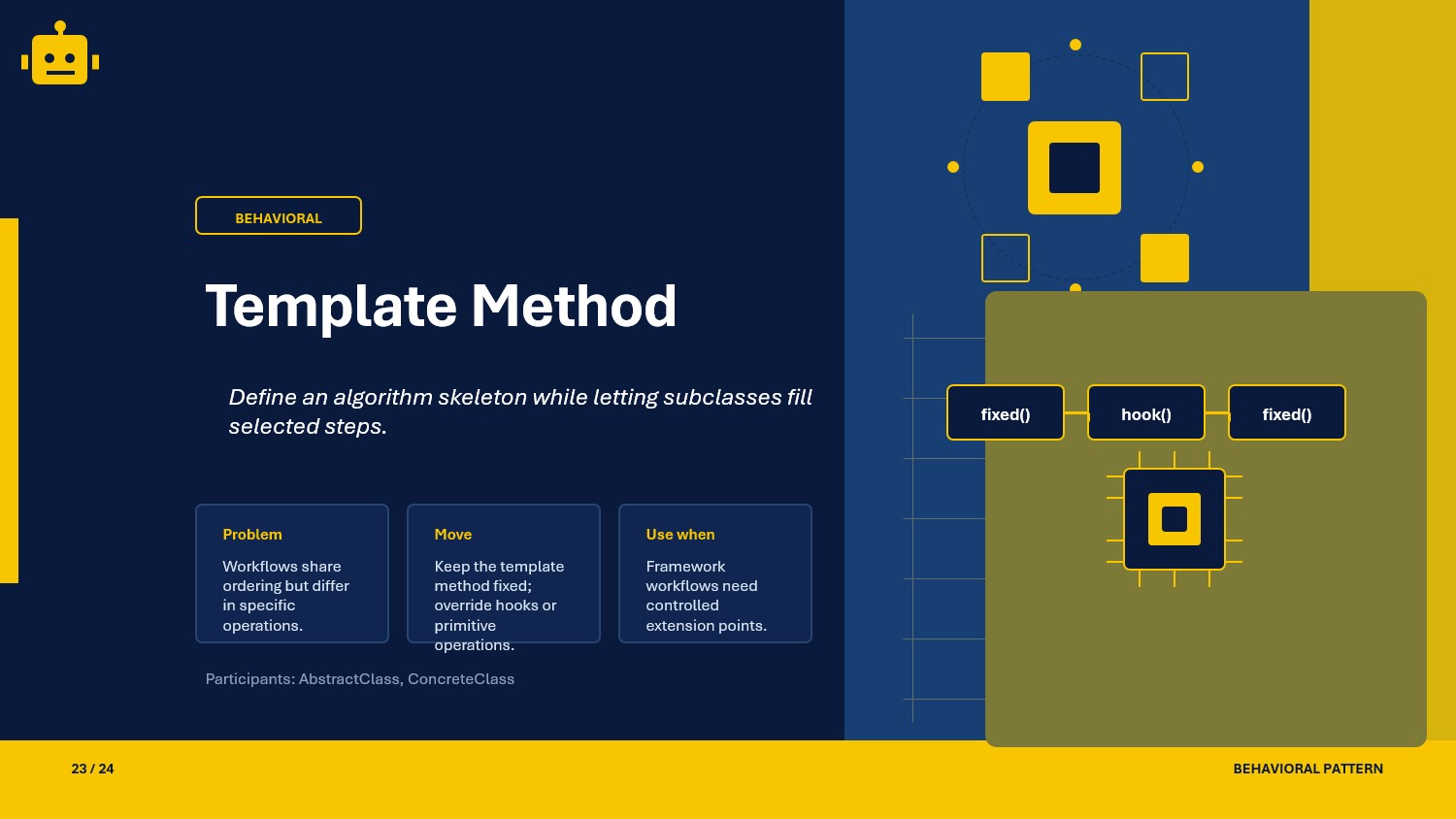
A practical Template Method pattern guide in C# with abstract class and hook-based variants for fixed workflows.
Intro
Many workflows follow the same overall sequence but vary in a few steps. The Template Method pattern keeps the sequence stable while allowing subclasses to customize selected parts.
What Is the Template Method Pattern?
Template Method is a behavioral design pattern that defines the skeleton of an algorithm in a base class and lets subclasses override selected steps.
In .NET, it is useful for pipelines, report generation, request validation flows, and processing steps that should stay ordered.
Template Method Class Example
The example below models a document generation pipeline.
public abstract class DocumentGenerator{    public void Generate()    {        Prepare();        BuildContent();        Publish();    }
    protected virtual void Prepare() { }    protected abstract void BuildContent();    protected virtual void Publish() { }}
public sealed class InvoiceGenerator : DocumentGenerator{    protected override void BuildContent()    {        Console.WriteLine("Building invoice content");    }}
Why This Works
The base class owns the algorithm order, while subclasses customize only the variable steps. This keeps the flow consistent without duplicating the overall sequence.
When to Use It
Template Method is a strong fit when the process order should remain fixed.
- report or document pipelines
- import/export workflows
- validation and processing templates
- base service classes with customizable hooks
- API steps that must run in a stable order
If the order itself changes often, a strategy or pipeline abstraction may be better.
Important Note for ASP.NET Core
In ASP.NET Core, template methods often appear in base controller classes, background job processors, or service base classes. Keep the fixed flow in the base class and let specialized services override only the parts they need.
builder.Services.AddScoped<InvoiceGenerator>();That approach keeps shared concerns like logging or validation consistent across derived implementations.
Core Components of the Pattern
| Part | Purpose | Example in this article |
|---|---|---|
| Abstract class | Defines the algorithm skeleton | DocumentGenerator |
| Primitive operations | Steps subclasses override | BuildContent() |
| Hooks | Optional steps subclasses can skip | Prepare() and Publish() |
| Concrete subclass | Supplies custom behavior | InvoiceGenerator |
Common Template Method Variations
You will commonly apply the Template Method pattern in these two forms:
Abstract Class Template
The base class contains the stable algorithm and abstract steps.
public abstract class WorkflowTemplate{ public void Run() { }}Hook Methods
Hooks are optional override points that let subclasses influence the flow without replacing it.
protected virtual bool ShouldPublish() => true;How the Variations Differ
| Variation | Control of sequence | Flexibility | Best use case |
|---|---|---|---|
| Abstract Class Template | Base class owns the sequence | Medium | Stable multi-step processes |
| Hook Methods | Base class owns sequence with optional overrides | Higher | Processes with optional branches |
SOLID Principles Behind It
SRP - Single Responsibility Principle
The base class manages structure while subclasses manage variations.
OCP - Open/Closed Principle
New behavior can be added by subclassing instead of changing the base algorithm.
LSP - Liskov Substitution Principle
Derived classes can stand in for the template base without breaking the expected flow.
Advantages and Disadvantages
Advantages
- preserves a stable workflow order
- reduces duplicated orchestration logic
- makes variation points explicit
- works well for shared pipelines
Disadvantages (and Optional Alternatives)
- inheritance can be restrictive when behavior changes frequently Optional pattern: Strategy (when step selection should be composition-based).
- too many hooks can make the base class harder to understand Optional pattern: Pipeline or Mediator (when the orchestration should be composed externally).
- subclassing ties variation to type hierarchy Optional pattern: Command (when each step should be an object instead).
UML Diagram
classDiagram    class DocumentGenerator {        <<abstract>>        +Generate()        #Prepare()        #BuildContent()        #Publish()    }    class InvoiceGenerator
    InvoiceGenerator --|> DocumentGenerator
A Quick Usage Example
DocumentGenerator generator = new InvoiceGenerator();generator.Generate();The caller invokes one stable workflow while the derived type fills in the variable behavior.
How to Validate the Pattern
Use these checks to confirm your Template Method implementation is healthy:
- the base class should own the sequence
- subclasses should override only variation points
- hook methods should be optional and safe by default
- tests should confirm the order does not change accidentally
- derived classes should not duplicate the full algorithm
Is there any other way to check our implementations
- yes, add tests that assert base-step ordering and derived-step customization
- add regression tests for hooks so optional behavior stays predictable
Summary
The Template Method pattern keeps common workflows consistent while allowing targeted overrides for the parts that vary. In .NET APIs, it is a clean fit when you want a shared algorithm skeleton with controlled extension points.